

A high asking price is not proof of resale value. A side hustle reselling tool should help you compare live opportunities with completed-sale evidence before you commit capital, rather than encourage a purchase based on optimistic listings alone.
Manual research makes that comparison slow and inconsistent. Listings and sold records sit across marketplaces, and they answer different questions. A repeatable sourcing workflow brings together active listings, completed sales, and estimated profit to help you assess a potential spread. INFLUCTS searches live marketplace listings across your country, compares them with completed-sale data, and provides AI-driven product search and automated profit analysis.
You’ll learn what to examine before buying, how resale software can sharpen opportunity screening, and where its analysis stops. It can organize market signals and inform a sourcing decision, but it cannot verify an item’s condition, remove selling costs or market risk, or guarantee a profitable sale. Those judgments remain yours. The goal is to make each sourcing decision more deliberate, evidence-led, and repeatable.
Key Takeaways
- Use a side hustle reselling tool to structure product research, then review each candidate before committing money.
- Separate current asking prices from completed-sale evidence to judge whether a potential spread is supported by actual market activity.
- Compare manual browsing with software-supported research to see where a more repeatable workflow can save effort.
- Apply a consistent checklist to screen products and make sourcing decisions with clearer evidence.
- INFLUCTS combines AI-driven search, marketplace listings, completed-sale comparisons, and profit analysis to inform research.
Why a Side Hustle Reselling Tool Starts with Better Sourcing Decisions
Manual browsing turns sourcing into a fragmented comparison task. You move between marketplaces, interpret different listing details, and try to match current offers with evidence of what buyers have purchased. Without consistent criteria, two similar candidates can receive very different levels of scrutiny. That makes cross-market opportunity assessment slow, especially when you’re deciding whether to commit limited capital.
A side hustle reselling tool organizes marketplace research to support sourcing decisions. Its value is not simply displaying products. It helps put current listings and market evidence into a form you can assess before buying.
Quotable definition: Reselling research software analyzes market information to inform sourcing decisions; a transaction platform enables buyers and sellers to complete purchases or sales.
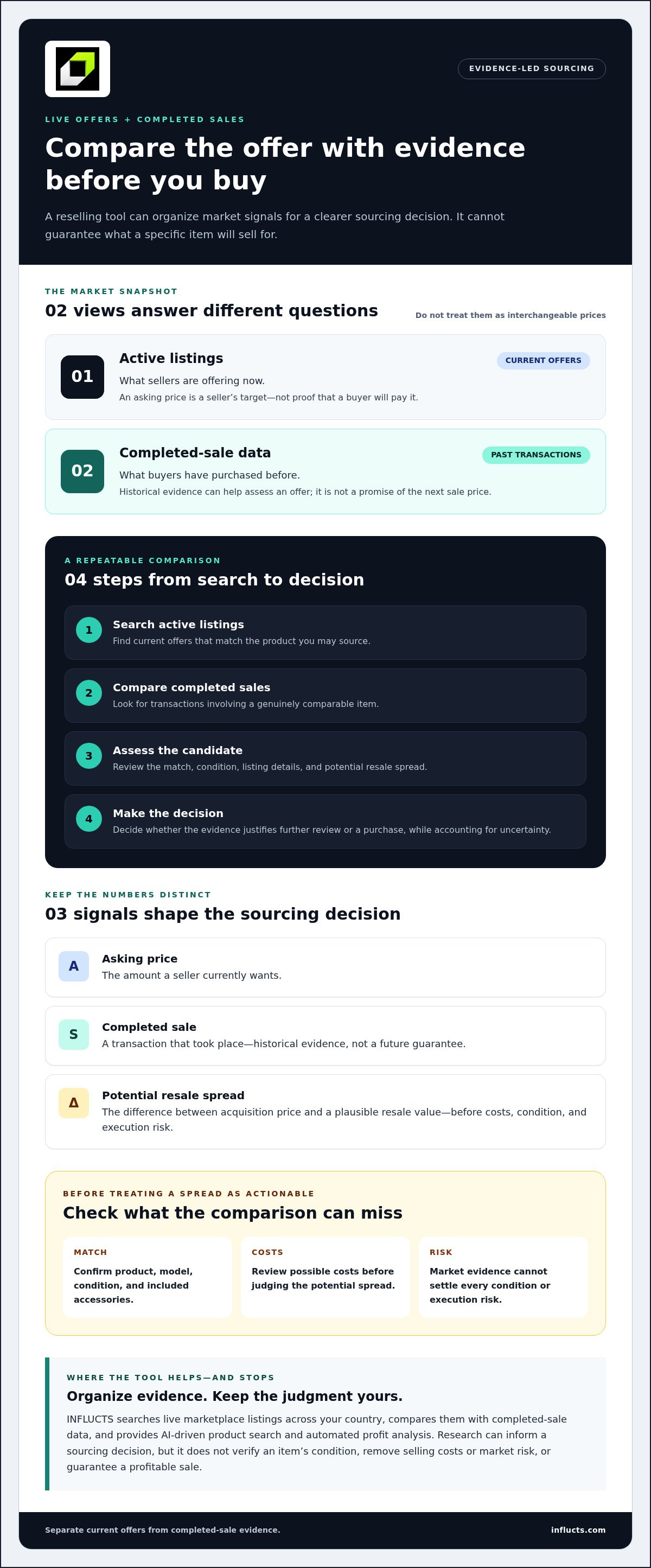
Keep three signals distinct. An asking price is what a seller currently wants. A completed sale records a transaction that took place, offering historical evidence rather than a promise of what the next item will sell for. A potential resale spread is the difference between a candidate’s acquisition price and a plausible resale value, before accounting for costs, condition, and execution risk. The concept connects to What is Arbitrage?, where price differences across markets create a possible opportunity, not a guaranteed outcome.
What a reselling tool does in a sourcing workflow
Research software can surface active listings and organize market evidence so you can compare candidates without relying on memory or scattered browser tabs. It helps you identify what is available and decide whether a listing merits closer review.
That support has a clear boundary. Software research does not buy an item, create its marketplace listing, pack or ship it, or complete a sale. You remain responsible for checking whether the item matches the evidence, evaluating its condition, judging demand, and accounting for execution risks that market data cannot settle.
Why manual browsing becomes a constraint
Manual comparison requires you to locate relevant listings, distinguish comparable products, and record separate data points across platforms. Differences in model, condition, accessories, or listing description can undermine a comparison. If you use different criteria each time, your sourcing decisions become difficult to assess consistently.
An asking price can distort the picture because it shows a seller’s target, not proof that buyers will pay it. Imagine a collectible listed at a high price while comparable completed sales show lower transaction values. The visible listing may suggest a wide spread, but the sold evidence may narrow or erase it. Treat the asking price as a lead to investigate, not a valuation.
- Match the product and condition before comparing prices.
- Separate current offers from completed-sale evidence.
- Review possible costs and risks before treating a spread as actionable.
A consistent research process does not remove uncertainty. It makes the basis for a buy decision visible, helping you reject weak candidates earlier and reserve deeper review for opportunities supported by stronger evidence.
How a Side Hustle Reselling Tool Combines Live Listings and Sold Data
A useful sourcing comparison starts with two views of the market: what sellers are offering now and what buyers have purchased before. A side hustle reselling tool can bring those signals into one research process, but they answer different questions. Current listings show available offers. Completed-sale data provides historical transaction evidence. Neither establishes what a specific item will ultimately sell for.
Quotable distinction: Live listings show current seller offers; completed-sale records show past transactions that can help assess those offers.
Use the evidence in sequence, not as interchangeable price points:
- Search active listings. Identify current offers that match the product you may source.
- Compare completed sales. Look for transactions involving a genuinely comparable item.
- Assess the candidate. Review the match, condition, listing details, and potential resale spread.
- Make the decision. Decide whether the evidence justifies further review or a purchase, while accounting for uncertainty.
From active product listings to comparable market evidence
AI-driven search can surface active marketplace listings across marketplaces in a user’s country, giving resellers a broader set of current offers to investigate. Search results are a starting point, not a ready-made valuation. Before comparing prices, confirm that listings refer to the same product or a close equivalent. Differences in model, included accessories, condition, or other relevant details can make two apparent matches poor comparables.
For example, a used device offered with accessories should not be treated as identical to a listing for the device alone without considering that difference. Compare the item’s defining details first, then treat the asking price as evidence of a seller’s current offer, not proof that a buyer has accepted it.
How completed-sale data sharpens the comparison
Completed-sale records add a separate reference point: they show transactions that occurred, rather than prices sellers hope to receive. Compare relevant records where available, paying attention to whether the item and its condition resemble the candidate. A mismatch can make a past sale less useful, even if the product name appears identical.
Historical transactions can strengthen or weaken the case suggested by current listings, but they don’t predict future demand. The item may differ, buyer interest may shift, or the eventual sale price may not match any past result. Treat the records as evidence for judgment, not a forecast or guarantee. This disciplined approach aligns with The Importance of Data-Driven Decisions in Retail, where market information supports more informed decisions.
INFLUCTS combines AI-driven search for active listings with completed-sale comparisons and automated profit analysis, giving you a structured basis for reviewing sourcing candidates. Explore INFLUCTS resale market intelligence to bring those signals together in your research. The tool informs the decision; you still determine whether the product, evidence, and execution risk make the opportunity worth pursuing.
Manual Research vs. a Reselling Tool: Compare the Workflow, Not the Hype
A software-supported workflow can make sourcing research more consistent, but it doesn’t turn uncertain market signals into guaranteed profit. The practical comparison is not “manual or automatic.” It’s whether you can review candidates using a repeatable process, relevant evidence, and your own checks before committing capital.
Dimension
Manual browsing
Software-supported research
Repeatability
Criteria and notes can vary between searches unless you record them consistently.
Can organize research signals into a more consistent workflow for comparing candidates.
Coverage
You visit sources individually and decide which listings to examine.
Can surface active listings across marketplaces within the software’s supported search scope.
Evidence
You assemble current offers and completed-sale references yourself.
Can consolidate market information, but you still need to judge whether the comparisons are relevant.
This is the role of a side hustle reselling tool: reduce the friction of gathering and organizing evidence, not make the buy decision for you. Research intelligence also differs from adjacent software and services. Crosslisting tools help distribute listings; bookkeeping tools organize financial records; inventory systems track stock; transaction platforms support sales. Don’t assume those functions are included simply because a product is described as a reselling tool.
Where manual research remains useful
Manual browsing is valuable when you’re learning a category, inspecting listing context, or trying to understand why similar-looking items differ in value. Opening a listing directly can reveal details that a short search result cannot convey, including variations in condition, accessories, model, or presentation.
The constraint is repetition. Moving among separate tabs and recording comparisons from memory makes it harder to apply the same criteria to each candidate. Manual research isn’t obsolete; it works well as a verification layer, especially when you need context beyond the summarized evidence.
What a research tool can and cannot establish
Software can surface market evidence and help analyze whether an opportunity merits closer review. It cannot establish an item’s physical condition from price data alone, guarantee buyer demand, or ensure a completed sale. A favorable comparison is a signal for investigation, not a prediction.
Before acting, assess what the analysis may leave out: item condition, selling fees, shipping, returns, and the work required to execute the resale. These factors affect realized outcomes. Don’t assume a research tool automatically captures every cost or operational detail. Review the assumptions behind any estimated spread, then decide whether the candidate still makes sense.
Use software to improve consistency and focus your attention. Use firsthand review to validate the product and its context. You remain accountable for the final decision and the risks attached to it.
A Practical Checklist for Using a Side Hustle Reselling Tool
Use the same review sequence for every candidate. A repeatable checklist limits rushed decisions and makes it easier to see why an item passed or failed. Treat tool output as research input, then verify the details that determine whether a potential resale makes sense.
Review a candidate before committing capital
Move through these checks in order. If the product match or market evidence is weak, pause before assessing the rest.
- Confirm the product match. Check the model, version, included accessories, and other identifying details. Similar titles can describe materially different items.
- Compare condition carefully. Assess whether the candidate’s condition is comparable to the items in the completed-sale records. A used item and a new or refurbished one aren’t direct equivalents.
- Review current listings and completed sales separately. Use current listings to understand available offers. Compare the candidate with relevant completed-sale evidence before considering a purchase; don’t rely on asking prices alone.
- Check the intended selling channel. Review its rules and requirements for the product, category, and listing. A promising comparison doesn’t establish that the item can be sold there as planned.
- Account for transaction friction. Consider relevant fees, shipping, possible returns, and the effort required to prepare and fulfill a sale. Don’t assume a research estimate captures every cost or operational detail.
- Make a decision, not an assumption. Automated profit analysis can help assess a candidate, but it can’t guarantee a profitable sale. Proceed only if the evidence and your own review support the risk.
Build a repeatable research routine
Record the reason for each decision. Note which product details matched, which completed-sale records informed your judgment, what risks affected the assessment, and why you passed or proceeded. These brief notes create a consistent basis for comparing future candidates and help reveal whether your criteria are changing without a clear reason.
Market evidence can shift. Revisit a candidate if current listings change or completed-sale patterns no longer support your earlier assessment. Keep the original notes rather than silently replacing them; the difference shows what changed and why a decision may need another look. For a deeper product-level assessment, use the same checks to validate the listing, its comparables, and the assumptions behind your expected resale value.
This is the practical role of a side hustle reselling tool: organize research signals so you can apply a disciplined review, not replace your judgment. INFLUCTS brings AI-driven search, active listings, completed-sale comparisons, and automated profit analysis into that sourcing workflow. Explore INFLUCTS resale research to evaluate candidates with market evidence before committing capital.
How INFLUCTS Supports a More Evidence-Led Reselling Side Hustle
Once the sourcing workflow is clear, the next step is applying it consistently. INFLUCTS is resale market intelligence software built to help side hustlers and professional resellers research potential opportunities. It brings AI-driven product search, active marketplace listings, completed-sale comparisons, and automated profit analysis into the sourcing process.
Match INFLUCTS capabilities to the research workflow
Start with discovery. INFLUCTS uses AI-driven search to find active marketplace listings across the user’s country. Those current offers give you candidates to investigate, not a ready-made buy list. Confirm the product match and decide whether a result fits your sourcing criteria.
Next, use the comparison between active listings and completed-sale data to examine a candidate against market evidence. The two sources serve different purposes: current offers show what sellers are asking, while completed sales show historical transactions. INFLUCTS brings these signals together for review, but past results don’t guarantee a future sale at the same price.
Automated profit analysis adds another input to the decision. Use it to assess a possible opportunity, then review assumptions and factors that may affect your actual outcome. Item condition, selling-channel requirements, fees, shipping, returns, and execution remain part of your evaluation. The analysis informs your judgment; it doesn’t replace it.
Choose a next step based on your operating stage
If you’re new to reselling, keep the first research cycle focused. Select a candidate listing, compare it with relevant completed-sale evidence, and note what supports or weakens the case for buying. This helps you build familiarity with product matching and market signals before broadening your search.
If you already source regularly, use the research workflow to structure repeated reviews. Apply consistent criteria to candidates, record why each passed or failed, and revisit the evidence when market conditions change. This makes comparisons across sourcing decisions clearer without assuming that research software handles inventory, listings, fulfillment, or sales.
Keep the operating principle simple: use market intelligence to identify candidates, validate the evidence, and make the purchase decision yourself.
INFLUCTS brings active listings, completed-sale comparisons, and automated profit analysis into a resale research platform. Explore the INFLUCTS resale research platform to evaluate sourcing opportunities with a structured view of market evidence.
Make Your Next Sourcing Decision More Deliberate
The next advantage comes from applying the same standard before every purchase. Set clear criteria for what deserves further research, record what changes your view, and be willing to pass when the evidence doesn’t meet your threshold. That discipline can help you refine how you source without treating any single opportunity as certain.
A side hustle reselling tool is most useful when it fits this decision process: it can organize research, while you remain accountable for the judgment and the capital at risk. Use it to investigate opportunities with greater focus, not to outsource the decision.
Put that approach into practice with INFLUCTS resale market intelligence. Build a more consistent research routine, assess each opportunity on its evidence, and move forward with a clearer basis for your next sourcing decision.
Frequently Asked Questions
Is a side hustle reselling tool worth it for beginners?
Yes, a side hustle reselling tool can be useful for beginners if it makes research easier to apply consistently. Start with a familiar product category and compare candidates using the same criteria. Note why each item seems worth investigating and what could weaken the case. Judge the tool by whether its workflow helps you make clearer decisions, not by expecting it to produce a particular return.
How does a reselling tool find products to resell?
Research software searches active marketplace listings and surfaces items for you to assess. A more precise search begins with identifying details, such as a model or version, rather than a broad product label. Then verify the listing details and compare the candidate with relevant sales evidence. A surfaced result is only a lead: it doesn’t establish that the item is in suitable condition or that buyers will want it.
Can reselling software guarantee a profit?
No. Software can support analysis, but it can’t ensure that an item sells or that its final sale price matches an earlier transaction. A candidate may appear promising before you account for its actual condition, selling costs, or the work needed to complete the sale. Treat an automated estimate as one input. Check its assumptions, consider what may be missing, and decide how much uncertainty you’re prepared to accept.
What is the difference between active listings and completed-sale data?
Active listings show current offers, while completed-sale data records transactions that have already happened. Several active listings for a product may be priced high, but that alone doesn’t show buyers are paying those amounts. Past sales give you another reference, provided the products and conditions are comparable. Use both sources to assess a candidate, while recognizing that neither establishes its future sale price.
Do I need a reselling tool to start a side hustle?
No. You can begin manually with one product category and a simple record of what you researched, what evidence you found, and why you chose to proceed or pass. That approach can help you learn your own criteria. A tool may become useful as searches across marketplaces become harder to track or compare. Choose based on the demands of your workflow, not the expectation that software creates profitable opportunities on its own.
What should I check before buying a product to resell?
Confirm that your candidate and comparison items match in meaningful details, including model and condition. Check the intended selling channel’s applicable rules, then account for relevant fees, shipping, and possible returns. Write down the assumptions behind your expected resale value and consider how the decision changes if those assumptions are wrong. A quick review of these points can expose a weak opportunity before you commit capital.