

A low purchase price can still produce a costly mistake. The real test is whether buyers are completing purchases at prices that leave room for profit. If you're learning how to find products to resell, start with marketplace evidence, not discounts or appealing listings alone.
A crowded marketplace or low asking price can look like reliable demand, but active listings show competition and seller expectations, not whether products are selling. That gap can make research scattered and tie up capital in slow-moving inventory.
This guide lays out a repeatable process for setting sourcing constraints, finding candidates, comparing active listings with completed-sale data, and estimating net profit after costs such as fees, shipping, and returns. You’ll learn how to prioritize research before committing capital, and how multi-marketplace tools such as INFLUCTS can bring product discovery and profit analysis together. The goal is a better-supported sourcing decision, not certainty.
Key Takeaways
- Learn how to find products to resell by setting sourcing constraints before generating candidates.
- Identify discovery channels and account for differences in location, platform rules, and sourcing access.
- Compare candidates using demand evidence, competition, handling needs, and listing consistency.
- Use a research log to track each lead, its evidence, and the next action in a repeatable workflow.
- See how INFLUCTS brings active listings, completed-sale comparisons, and profit analysis into product research.
How to Find Products to Resell: Start With a Framework
Effective sourcing starts before you browse listings. Treat it as a two-part process: identify product candidates, then collect evidence to decide which deserve further research. A product that looks appealing is only a lead. Demand, competition, sourcing access, handling requirements, and fit with your selling channel determine whether it merits consideration.
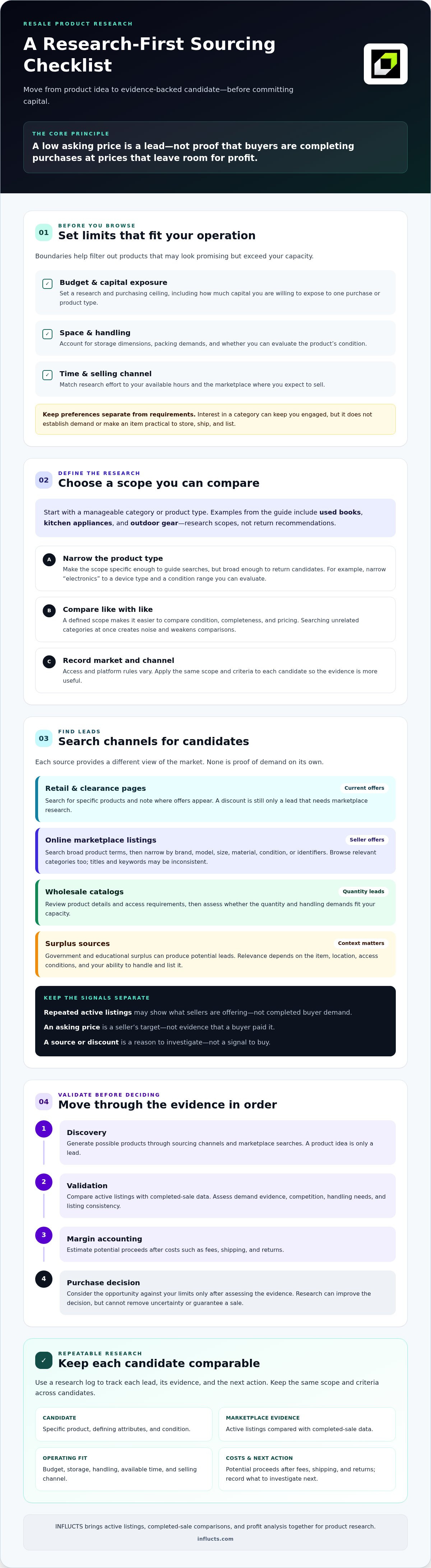
Keep each decision in its proper stage. Discovery generates possible products. Validation tests whether marketplace evidence supports further investigation. Margin accounting evaluates costs and potential proceeds in detail. The purchase decision comes last, after you’ve assessed the opportunity against your limits. Research can improve that decision, but it can’t remove uncertainty or guarantee a sale.
A product idea is appealing by instinct; a research-backed candidate is a specific item with evidence worth testing against your sourcing and operating constraints. This framework applies whether you resell occasionally or treat it as a business. For background on the role and model, see Understanding the Reseller Model.
Set operating limits before searching
Set boundaries before opening marketplaces. Decide your working budget and how much capital you’re willing to expose to any one purchase or product type. Then define practical limits: available storage, shipping effort, the product conditions you can assess, and the time you can allocate to research. These constraints filter out candidates that look promising but don’t fit your capacity.
- Budget: Set a research and purchasing ceiling, including an acceptable level of capital exposure.
- Space and handling: Account for storage dimensions, packing demands, and how you’ll evaluate condition.
- Time and channel: Match research effort to your available hours and the marketplace where you expect to sell.
Keep preferences separate from requirements. Interest in a product category can help you stay engaged, but it doesn’t establish demand or make an item practical to store, ship, and list.
Choose a product scope that can be researched
Start with a manageable category or product type, such as used books, kitchen appliances, or outdoor gear. These are examples of research scopes, not recommendations or claims about likely returns. A defined scope makes it easier to compare similar listings and spot differences in condition, completeness, and pricing. Searching unrelated categories at once creates noise and weakens comparisons.
Make the scope specific enough to guide searches but broad enough to return candidates. For example, narrow “electronics” to a type of device and a condition range you can evaluate. Record the market and selling channel you’re researching, since access and platform rules vary. Then apply the same scope and criteria to each candidate. Consistency makes marketplace evidence more useful and turns how to find products to resell into a repeatable process rather than an impulse-driven hunt.
Where to Find Products to Resell: Channels & Marketplaces
Once you’ve defined a workable product scope, search channels that can produce relevant leads. Start with retail listings, online marketplaces, clearance pages, and wholesale catalogs. Each offers a different view of the market: retail and clearance pages show current offers, marketplace listings show what sellers are presenting, and catalogs provide a way to investigate products available in quantity.
Sourcing channels produce leads, not proof of demand. Treat every result as a reason to investigate, not a signal to buy. Access and marketplace rules vary by location and platform, so a source that fits one selling model may not fit another.
Use marketplace listings to generate candidate leads
Search active listings using a broad product term, then narrow by brand, model, size, material, condition, or another defining attribute. Product identifiers can help distinguish similar versions when sellers include them. Browse relevant categories, too, since useful candidates may appear under unexpected keywords or inconsistent titles.
Repeated listings can reveal a pattern worth researching, such as several sellers offering the same model. But listing frequency shows what is being offered, not what buyers complete transactions for. An asking price is a seller’s target, not evidence that a buyer paid it. Keep those signals separate as you collect leads.
Expand discovery beyond one sourcing route
Retail and clearance searches can surface individual offers. Wholesale catalogs can show products offered in larger quantities, while marketplace-to-marketplace research can reveal differences between listings on different platforms. These routes involve different levels of access, repeatability, and research effort. None is automatically right for every reseller.
For a less conventional source, Sourcing from Government and Educational Surplus can introduce government and educational surplus assets as potential leads. Their relevance depends on the item, location, access conditions, and your ability to handle and list it.
Compare channels against your operating model rather than chasing the largest number of results:
- Retail and clearance pages: Search for specific products and note where offers appear. Treat discounts as leads that still need marketplace research.
- Wholesale catalogs: Review product details and access requirements, then assess whether the quantity and handling demands fit your capacity.
- Marketplace listings: Search across selling venues for product and identifier matches, then investigate completed-sale evidence separately.
Location matters. A marketplace may not serve every country in the same way, and platform policies or sourcing access can differ. Focus on channels you can use and listings relevant to the country and marketplace where you plan to sell. Record the source and search terms alongside each candidate so you can reproduce and compare your results instead of relying on memory.
For multi-marketplace discovery, INFLUCTS resale market intelligence brings active listing searches together with cross-market comparisons and completed-sale data. Use that evidence to prioritize candidates for deeper analysis, not as a guarantee of sales or profit.
How to Compare and Choose Resale Product Candidates
Candidate selection requires more than spotting a gap between two visible prices. Compare each lead against the same evidence and operating criteria, then advance only those that merit deeper review. This creates a consistent screen for how to find products to resell without treating any single signal as a verdict.
Compare evidence quality, not just visible prices
Active listings show what sellers are offering and how they describe their products. Completed-sale records provide a separate signal: evidence that transactions have occurred. Neither source answers every question. Listings can differ in version, condition, included components, and detail, so a superficially similar match may not be comparable.
Check that product identity and condition align before drawing conclusions. Record gaps or mismatches rather than treating an imperfect match as confirmation. Asking prices are not realized sale values, and a past completed sale does not assure a future one.
Screen for operational fit and competition
Assess each candidate against the limits you set earlier. Consider whether its sourcing route is accessible, its size fits your storage, and its condition and handling demands match your capacity. A candidate with promising evidence can still be a poor operational fit if acquiring, preparing, or shipping it exceeds your resources.
Use listing volume and repeated competition as context. Numerous active listings may indicate a crowded offer set, but they don’t prove buyer demand. Sparse listings aren’t proof of opportunity either. Review competition alongside completed-sale evidence and product consistency, not as a standalone decision rule.
Use this scorecard to compare candidates consistently:
- Demand evidence: Note the availability and relevance of completed-sale records. Keep them separate from active offers.
- Competition: Record the number and similarity of active listings. Look for recurring sellers or offer patterns without equating them with sales.
- Sourcing access: Describe where the product can be acquired and whether that route fits your location and selling model.
- Handling demands: Assess the practical fit for storage, condition assessment, preparation, and shipping.
- Listing consistency: Check whether listings and sale records refer to the same version, condition, and included items.
Make your notes specific. “Strong demand” is too vague to support a decision. Record what evidence you found, what didn’t match, and what still needs investigation. That makes comparisons more useful when you revisit candidates or weigh alternatives.
This screen prioritizes research; it doesn’t eliminate market or execution risk. A candidate that passes can still face changing competition, sourcing limits, or selling challenges. Reserve detailed cost and margin calculations for the next stage. Advance candidates with relevant evidence and workable operations, and set aside those that rely on assumptions.
How to Build a Repeatable Product-Discovery Workflow
A repeatable workflow turns scattered searches into a shortlist you can review and improve. Keep discovery focused: its purpose is to identify candidates and decide which merit deeper validation, not to prove that a product will sell. Follow the same sequence each time so you can compare research sessions.
- Define constraints. Set your budget, acceptable capital exposure, storage capacity, handling limits, research time, and intended selling channel. Keep these criteria visible while searching.
- Generate leads. Search selected categories, marketplaces, retail listings, clearance pages, or catalogs. Save plausible candidates without treating early results as purchase recommendations.
- Narrow candidates. Remove leads that clearly conflict with your limits. Group the rest by product category, sourcing route, or marketplace so you can compare like with like.
- Compare evidence. Review available active listings and completed-sale records. Note how closely the product versions, conditions, and listing details match.
- Record decisions. Rank candidates for further research, mark unresolved questions, and document why you advanced, paused, or rejected each lead.
Advance candidates only when the evidence matches your operating constraints. This rule prevents an interesting listing from overriding practical limits. It also grounds prioritization in fit and evidence, not unsupported profit promises.
Maintain a research log with one row per candidate. Capture the source, date searched, product name or identifier, version and condition, marketplace, relevant evidence, and next action. Make each next action specific, such as “compare matching completed-sale records” or “clarify whether the listed item includes the required component.” This makes it easier to resume research without repeating searches.
Rank the log by research priority. Candidates that fit your operating limits and have clearer evidence can move forward first. Grouping by category or source also reveals gaps: one group may have plenty of active listings but little comparable sale data, while another may have consistent product details but uncertain sourcing access. Keep rejected candidates and the reasons, too. A brief note such as “oversized for storage” or “product versions don’t match” helps prevent unproductive searches from cycling back into the shortlist.
Set a decision point before committing capital. A candidate should have a clearly identified product, a plausible sourcing route, relevant marketplace evidence, and no unresolved issue that would invalidate the comparison. Flag open questions about listing accuracy, condition, supply access, or platform policy instead of filling gaps with assumptions.
This is still a screening stage. Detailed checks on demand, competition, sourcing, and costs belong in product validation and margin analysis. Keep those steps separate so a preliminary shortlist isn’t mistaken for a purchase decision. A structured process improves how to find products to resell, but it can’t eliminate market or execution risk.
Use INFLUCTS resale research tools to bring active listing discovery, cross-market comparisons with completed-sale data, and profit analysis into your research workflow.
Use INFLUCTS to Find Resale Products With Marketplace Evidence
A repeatable discovery process connects product ideas to current marketplace evidence. INFLUCTS supports that workflow with AI-driven product search, active marketplace listing discovery across the user’s country, cross-market comparisons with completed-sale data, and automated profit analysis. These capabilities help organize research and prioritize candidates, but they don’t guarantee a sale or remove sourcing risk.
Move from product idea to searchable market evidence
Start with a defined product idea, category, or identifier. AI-driven search surfaces active listings across marketplaces in the user’s country, giving you a wider set of leads to review. Compare relevant listing details across channels, including product identity and condition, before treating results as comparable. Use the listings returned by the search to assess each candidate, rather than assuming every channel or item will appear.
This brings an early research task together: moving from a search concept to a set of live offers. Active listings show how sellers present products and the prices they ask. They don’t establish that buyers complete purchases at those prices. Keep that distinction visible as you screen candidates, and record gaps that need further investigation.
Prioritize candidates with cross-market research
Cross-market comparisons connect active listing discovery with completed-sale records. The two evidence types answer different questions. Listings show current offers and competition; completed-sale data records transactions for comparison. Review whether the products, versions, and conditions align. A mismatch can make an apparent comparison less useful, even when listings look similar at first glance.
Automated profit analysis adds another input to your research. Use it to assess and prioritize candidates, then consider the assumptions and operating constraints behind your decision. A calculated result is not a guaranteed margin: sourcing access, product condition, selling costs, and execution can affect the outcome. INFLUCTS brings discovery and analysis together, but it doesn’t make the purchase decision or eliminate inventory ownership and market risk.
To apply the workflow, search for candidates that fit your scope, compare active listings with completed-sale evidence, and use profit analysis to decide which leads warrant deeper review. Save unresolved questions rather than treating incomplete evidence as confirmation. This keeps research structured and preserves a clear distinction between promising candidates and a final sourcing commitment.
Use INFLUCTS resale research to bring marketplace discovery and cross-market evidence into your product research workflow.
Make Your Next Sourcing Decision Evidence-Led
Your next research session is an opportunity to improve your decision process, not simply add more candidates. Pick a focused category and decide what would make a lead worth advancing before you search. As marketplace evidence changes, revisit earlier decisions. Track which search approaches surface relevant candidates and where assumptions need stronger support.
This record won’t make outcomes certain. It will make your reasoning visible, so you can refine your criteria instead of relying on memory or impulse. That’s the practical advantage of learning how to find products to resell: each round of research can inform the next.
INFLUCTS supports ongoing research with resale market intelligence in one software workflow. Explore INFLUCTS resale research and put your next sourcing decision on a clearer evidence base.
Start with one candidate, apply your criteria, and build from there. Consistent research is a stronger foundation for confident decisions.
Frequently Asked Questions
Can I find products to resell without buying inventory first?
Yes. You can research potential products before purchasing inventory. Start by defining your limits, then examine listings and completed-sale records where available. For example, compare similar items across model versions and conditions before deciding what to investigate further. Research helps identify candidates for validation, but it doesn’t secure supply or remove the need to assess platform rules and sourcing risks before committing capital.
Is it better to find resale products locally or online?
Neither route is universally better. Local sourcing may let you inspect an item directly, which can help when visible wear or missing parts matter. Online searches can expose listings beyond your immediate area, but product condition may be harder to assess from listing details alone. Compare the information each route provides with the needs of the product, then choose the source that fits your access, time, and selling model.
How do I know whether a resale product is restricted on a marketplace?
Review the current seller rules and category requirements on the marketplace where you intend to list the item. Look for restrictions tied to product type, condition, seller eligibility, or required listing information. Seeing similar offers online doesn’t prove you can list the same item under the same terms. Treat policy review as a separate screening step, and revisit the marketplace guidance before sourcing because requirements can change.
Should beginners start with products they already understand?
Product familiarity can help you recognize model differences, identify missing components, and choose more precise search terms. It’s a useful starting point, not evidence of buyer demand. Beginners learning how to find products to resell can use familiar categories to generate leads, then verify that each candidate matches marketplace records. For unfamiliar products, proceed only if you can reliably identify the version and assess its condition.
How many resale product candidates should I research at once?
Research only as many candidates as you can assess carefully with the time available. A short, well-reviewed shortlist is more actionable than a long queue of unexamined ideas. If research time is limited, finish comparing one group of similar items before opening searches in unrelated categories. Set aside candidates with unresolved evidence gaps, and return to them when you can investigate those gaps properly.
Do I need to focus on one marketplace when searching for resale products?
No. Starting with one marketplace can simplify early research, but its listings may reflect a different audience or product mix than another platform. Compare additional marketplaces when relevant evidence is available, and match the exact product version and condition before interpreting differences. A wider search adds context, but it doesn’t replace checking whether records are comparable or whether the product fits your intended selling channel.
