

The highest-markup item can be the weakest resale opportunity. A tempting buy price and a strong listing price don’t reveal what remains after marketplace fees, shipping, packaging, returns, and price competition. Researching high margin products to resell takes more than making a list of popular categories.
Markup, gross margin, and net profit measure different things, and none guarantees an item will sell quickly. A category is worth investigating when its profit potential aligns with evidence of buyer demand, manageable sourcing, and a realistic path to selling through your stock.
This guide compares promising categories using those factors and explains how to calculate the economics before committing capital. You’ll learn which demand signals to examine, where high markups can mislead, and how to build a focused shortlist for further research. INFLUCTS brings active marketplace listings and completed-sale data into cross-market comparisons, with automated profit analysis to help evaluate prospective items. Use that evidence to assess both the potential return and the likelihood of selling the stock.
Key Takeaways
- Separate markup, gross margin, and net profit to see what remains after selling costs.
- Research lightweight accessories, hobby and craft supplies, home organization, and selected electronics accessories as possible starting categories.
- Compare demand evidence, margin headroom, liquidity, competition, and sourcing friction. Treat scores as research tools, not forecasts.
- Filter ideas against your capital, storage capacity, experience, and sourcing constraints before narrowing your shortlist of high margin products to resell.
- Use INFLUCTS to find active marketplace listings in your country, compare them with completed-sale data, and analyze prospective item profitability.
What Makes High-Margin Products to Resell Worth Considering?
A high markup can look attractive and still leave little take-home profit. The difference comes from costs between sourcing an item and keeping the proceeds: platform fees, fulfillment, returns, promotion, and price changes. There is no single margin threshold that makes a resale category worthwhile for every seller. The result depends on costs, selling channel, sourcing terms, and your capacity to handle the work.
Category examples are starting points for research, not promises of returns. Evaluate each opportunity using your expected costs and evidence of completed sales. Understanding the distinctions below makes comparisons more reliable.
How do markup, gross margin, and net profit differ?
Consider an illustrative item bought for $40 and sold for $100. Its $60 gross profit equals a 60% gross margin because gross profit is divided by the sale price. The same $60 is a 150% markup on the $40 purchase cost. Profit margin is expressed against revenue, while markup is calculated against cost.
Markup compares profit with cost; gross margin compares gross profit with revenue; net profit is what remains after relevant operating costs. These measures are not interchangeable. Gross margin generally subtracts the item’s direct acquisition cost from revenue. For a fuller resale calculation, include the purchase price and direct sourcing costs, such as inbound shipping, in the inventory cost basis.
Suppose platform fees, outbound fulfillment, packaging, expected return losses, promotion, and an allocated share of operating overhead total $25. The illustrative item then earns $35 in net profit before tax, not $60. If competition pushes the sale price down to $85 while those costs remain unchanged, net profit falls to $20. Recalculate using realistic selling prices rather than treating the original listing price as guaranteed revenue.
Why does resale liquidity matter alongside margin?
Liquidity is the ability to turn stock into completed sales within a period that fits your cash-flow needs. A product may show strong theoretical profit per unit but sell slowly, leaving capital tied up in inventory. That capital cannot be redeployed, and storage costs, markdowns, or changing demand can weaken the eventual return.
Separate visible supply from realized demand. An asking price shows what a seller hopes to receive. It does not prove a buyer paid that amount. Completed-sale records offer stronger evidence that similar items have sold, although they do not guarantee your next sale, its timing, or its price.
Before buying, compare recent completed sales with active listings for genuinely similar items. Check condition, model or version, included components, and selling channel. Many active listings alongside few completed sales can point to heavy competition or weak liquidity, even when advertised prices suggest generous margins.
Use this combined test for high margin products to resell: calculate profit after costs, then assess how reliably and quickly comparable stock sells. A modest return with credible turnover may suit your operation better than a larger projected margin attached to slow-moving inventory.
High-Margin Products to Resell: Categories to Research First
Use categories as hypotheses, not rankings. The same item type can perform differently depending on condition, sourcing channel, platform, and buyer demand. When researching high margin products to resell, compare workload and stock turnover alongside potential selling price. Compact goods can be easier to store and ship, but check whether completed-sale activity supports each specific idea.
Which compact, repeatable categories merit a closer look?
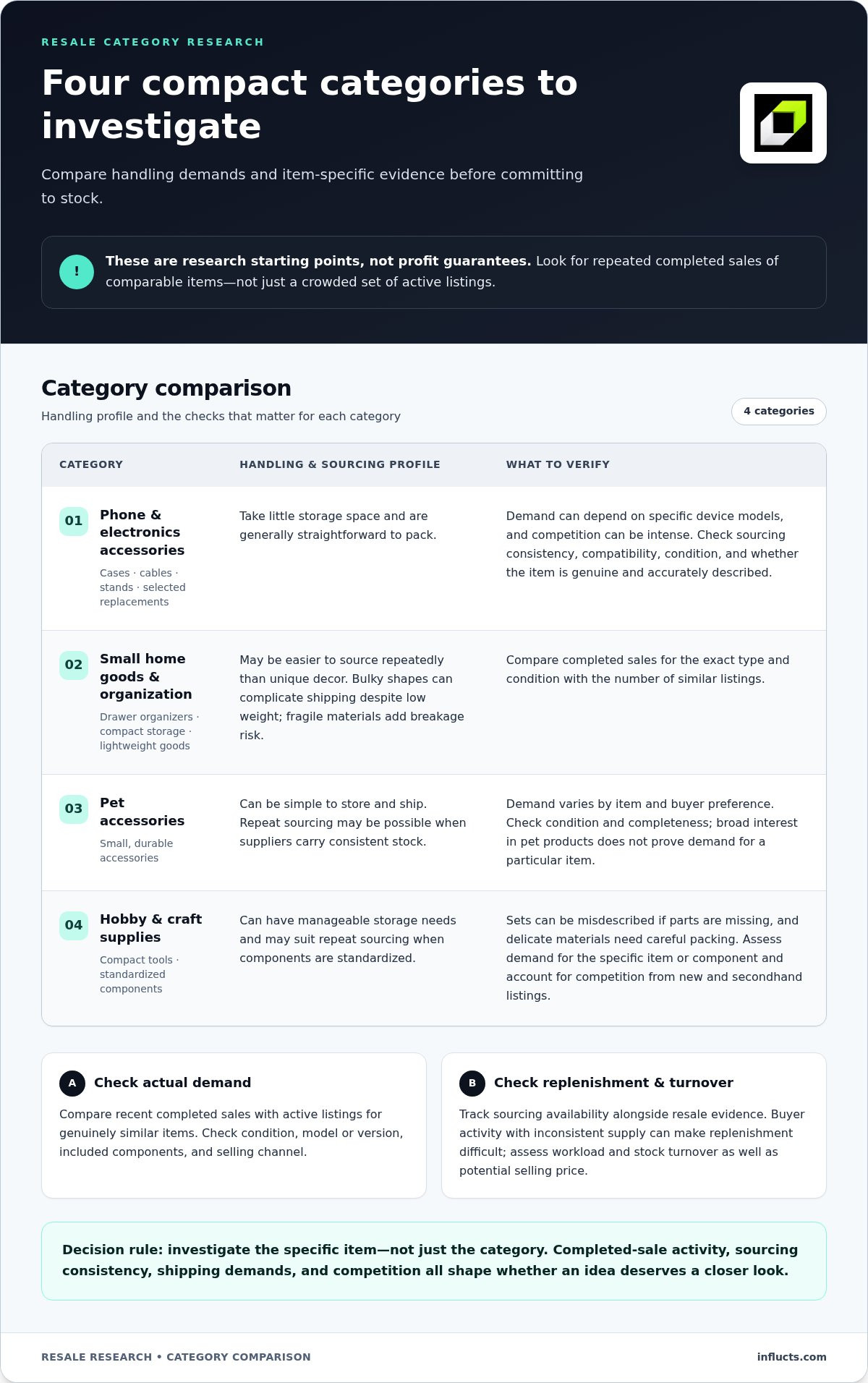
These options have different sourcing and fulfillment profiles. None is automatically profitable. Look for repeated completed sales of comparable items, not just a crowded set of active listings.
- Phone and electronics accessories: Cases, cables, stands, and selected replacement accessories take little storage space and are generally straightforward to pack. Demand may depend on specific device models, while competition can be intense. Check sourcing consistency, compatibility, condition, and whether the item is genuine and accurately described.
- Small home goods and organization: Drawer organizers, compact storage pieces, and other lightweight household items may be easier to source repeatedly than unique decor. Bulky shapes can make shipping more complex despite low weight, and fragile materials add breakage risk. Compare completed sales for the exact type and condition with the number of similar listings.
- Pet accessories: Small, durable accessories can be simple to store and ship. Repeat sourcing may be possible when suppliers carry consistent stock, but demand varies by item and buyer preference. Check condition and completeness, and don’t assume broad interest in pet products means buyers want a particular item.
- Hobby and craft supplies: Compact tools and supplies can have manageable storage needs and may suit repeat sourcing when components are standardized. Sets are easy to misdescribe if parts are missing, while delicate materials need careful packing. Assess demand for the specific item or component and account for competition from new and secondhand listings.
Track sourcing availability as well as resale evidence. A product with buyer activity but inconsistent supply may be difficult to replenish. Steady supply with few completed sales, on the other hand, can leave capital idle.
When can collectibles, beauty, or digital products fit resale?
Branded secondhand goods and collectibles need item-level scrutiny. Authenticity, condition, provenance, and specific buyer interest affect both achievable price and sell-through. Counterfeits, undocumented history, missing parts, or damage can undermine an attractive listing price. Check completed sales for the same version and condition before treating a collectible as a viable lead.
Beauty products bring condition and expiration risks, as well as category-specific marketplace rules. Verify that an item is eligible for resale and can be accurately represented. Avoid stock whose age, seal, or storage history creates uncertainty.
Digital products are not physical resale inventory. A file, template, or account is a resale candidate only if you have the appropriate ownership and transfer or resale rights. Without those rights, a product that seems easy to deliver can create a serious listing risk. Use cross-market resale research to compare active listings with completed-sale evidence before committing capital.
How to Compare Resale Categories Beyond Headline Margin
A high-margin product isn’t automatically easy or dependable to resell. A projected return matters only when buyers are completing comparable purchases, costs are accounted for, and stock can move at a useful pace. Compare categories with one consistent framework instead of relying on margin estimates built on different assumptions.
Score each factor from 1 to 5. For demand evidence, margin headroom, and liquidity, 5 is strongest. For competition and sourcing friction, 5 means the greatest obstacle. Use the same period, marketplace, and cost assumptions for every category. The scores organize research; they are not forecasts or guarantees.
| Factor | What to assess | Score direction |
|---|---|---|
| Demand evidence | Completed sales of closely comparable items | 5 = repeated, relevant sale evidence |
| Margin headroom | Expected sale proceeds after consistent cost estimates | 5 = more room remains after costs |
| Liquidity | How reliably comparable items sell within your target period | 5 = stronger evidence of timely turnover |
| Competition | Comparable active listings and price pressure | 5 = crowded or aggressive competition |
| Sourcing friction | Supply consistency, preparation, testing, and handling | 5 = harder to source and process |
Record the evidence behind each score. A number without a note can conceal assumptions. For example, note whether sales match the item’s condition and version, and whether the expected selling price comes from completed transactions or current listings.
Which signals indicate demand without overstating certainty?
Compare completed sales with current active listings for comparable items over the same recent period. Match condition, model, bundle contents, and listing details as closely as possible. A sale for a complete, tested item may not support the same price for an incomplete or untested one. Look for recurring completed transactions rather than relying on a single unusual result.
Completed sales show what buyers paid; active listings show what sellers hope to receive. Neither guarantees your next sale, but transaction evidence provides a firmer price reference than asking prices alone.
How do operating costs change category comparisons?
Apply one cost template to every candidate: acquisition and inbound transport, marketplace and payment charges, packing materials, outbound shipping, and expected return costs. Add storage, testing, refurbishment, or authenticity checks when the category requires them. Make assumptions explicit, especially when actual costs depend on item size, condition, or selling channel.
This prevents an accessory with a low handling burden from being compared unfairly with a fragile item that needs testing and protective packing. Recalculate when the likely sale price changes. For high margin products to resell, favor categories that retain attractive economics after consistent cost treatment and show credible buyer activity, not just appealing listings.
How to Build a Focused Shortlist of Products to Resell
A shortlist should fit the operation you can run, not just the returns you hope to achieve. Set boundaries before evaluating product ideas: available capital, storage capacity, relevant experience, and sourcing constraints. These filters remove opportunities that demand more space, cash, or specialist judgment than you can provide.
How can resellers match categories to their operating constraints?
Match handling requirements to your setup. Compact goods can suit limited storage, while bulky items need adequate space and a workable packing and shipping process. Fragile or perishable goods add handling and timing risks. Regulated or authenticity-sensitive categories may need extra checks. Favor products you can evaluate accurately and source with reasonable consistency.
Then narrow the field to a focused shortlist of category or item ideas. Compare them using the same marketplace observations and cost assumptions instead of judging each by a different standard. For high margin products to resell, operational fit is part of the opportunity: a category is less useful if you cannot inspect, store, or replenish its stock reliably.
How should a shortlist be documented before buying?
Create a compact record for each candidate. Keep observed marketplace evidence separate from estimates and personal assumptions. This makes weak evidence visible and helps prevent an optimistic asking price from becoming an assumed sale price.
- Market evidence: Note comparable active listings and completed-sale observations, including relevant condition, model, and listing details.
- Supply assumptions: Record the expected acquisition source, likely availability, and any uncertainty about repeat sourcing.
- Cost inputs: List purchase and inbound costs, platform and payment charges, packing, shipping, storage, and likely return or preparation costs.
- Decision limits: Set the maximum capital exposure, acceptable holding period, and a practical exit option if demand or prices weaken.
Cross-market research adds context. INFLUCTS uses AI-driven search to find active listings across marketplaces in your country, compare them with completed-sale data, and automate profit analysis. Use INFLUCTS resale research to compare evidence across candidate items before deploying capital.
Consider a controlled test only after you understand likely costs, exposure, and exit options. Keep the test small enough that slow sales or a lower-than-expected selling price won’t disrupt your operation. Define what evidence would justify continuing, such as repeated completed sales at prices that still support your cost assumptions. If results differ from your research, update the assumptions before expanding. A shortlist is a decision tool, not a purchase commitment.
Use INFLUCTS to Research High-Margin Resale Opportunities
Once you’ve narrowed your categories and defined what makes an item viable for your operation, compare marketplace evidence before committing capital. A price gap between platforms can point to an opportunity, but it doesn’t prove that the item will sell at the higher price or that costs will leave enough profit. Treat each signal as a research input and assess whether it fits your sourcing and fulfillment constraints.
How does cross-market research support category decisions?
INFLUCTS uses AI-driven search to find active product listings across marketplaces in your country. It compares live listings with completed-sale data and automates profit analysis for prospective items. This listing-to-sale comparison helps you assess current asking prices alongside evidence of buyer transactions across markets.
Use that context to refine a product idea. If active listings show a range of prices, check whether completed sales support the price you need and whether sold items match the condition, version, or bundle you can source. Differences between markets may be worth investigating, but they can also reflect different item details, competition, or selling conditions.
Category-level interest is only a starting signal. Research specific, comparable items before estimating a return. If one type of accessory appears active, for example, compare like-for-like versions rather than treating every item in the broad category as equivalent. Then weigh the sale evidence against acquisition, marketplace, and fulfillment costs. Automated analysis can structure the comparison, but it cannot remove uncertainty about future prices, sales timing, or product availability.
What is the next step after choosing a category?
Turn the category into a short research sequence: define capital, storage, experience, and sourcing limits; compare active listings with completed sales; account for realistic costs; then assess risks such as slow turnover, price pressure, or difficult quality checks. Keep your assumptions visible. If the evidence changes, revise your assessment before increasing your commitment.
INFLUCTS provides resale market intelligence software to research opportunities and compare marketplace evidence. Use it to evaluate an item before deciding whether it merits further action. The analysis can sharpen your decision process, but it doesn’t guarantee a margin, a sale, or a particular return.
Explore INFLUCTS resale market intelligence
Turn Your Next Product Idea Into a Testable Decision
Your next move doesn’t need to be a large inventory commitment. Choose one product hypothesis and decide in advance what evidence would support it, what would weaken it, and when you’ll reassess. Clear decision rules help separate a promising signal from the temptation to chase a headline price.
Apply consistent criteria as you compare ideas. That makes it easier to spot whether an apparent opportunity depends on an unusually high asking price, a one-off sale, or assumptions that don’t fit your operation. This discipline can make your search for high margin products to resell more selective and capital-aware.
Use INFLUCTS to bring marketplace evidence into your research, then make the buying decision with your own constraints and risk tolerance in view. Explore INFLUCTS resale market intelligence and put your next product idea to a more informed test.
Frequently Asked Questions
What are the best high-margin products to resell?
No category is universally best. Small accessories, craft supplies, home goods, and selected collectibles can be useful starting points, but performance depends on the specific item and selling conditions. Compare products with similar condition and features, then check whether the expected sale price leaves room after costs. A category is worth further research when its sourcing fits your operation and comparable buyer activity supports continued investigation.
Is a high markup the same as a high profit margin?
No. Markup compares the difference between selling price and acquisition cost with the acquisition cost. Gross margin compares gross profit with revenue. For example, an item bought for $20 and sold for $30 has a 50% markup and a gross margin of about 33% before other expenses. Net profit subtracts additional operating costs. State which measure you’re using so product comparisons remain meaningful.
Can a product have a high margin but still be a bad resale choice?
Yes. A large apparent price spread can be offset by weak buyer activity, expensive handling, or uncertain sourcing. Consider a specialized item that requires testing before listing: the extra work may reduce the return, while limited sales evidence makes turnover harder to judge. Ask what happens if the first price target fails. If a realistic markdown erases the return or leaves stock difficult to move, the opportunity may not suit your risk tolerance.
How do I find products with high resale demand?
Start with products you can source and evaluate confidently, then examine sales activity for specific versions rather than broad categories. Separate routine transactions from unusual outliers, and compare similar items over a consistent period. Seasonal products need extra care: a burst of sales during a peak period may not reflect demand throughout the year. Rechecking the evidence at different points helps you avoid treating a brief spike as stable interest.
Are digital products good products to resell?
They can be, but only if your rights allow resale or redistribution. A purchase receipt alone may not grant those rights; review the license terms for transfer limits, permitted users, and restrictions on commercial use. Also account for costs that don’t involve shipping, such as platform charges, customer support, updates, or promotion. If the rights or ongoing obligations are unclear, don’t treat the product as ready to list.
What costs should I include when calculating resale profit?
Build a per-item cost record that reflects how you plan to sell, not an idealized transaction. Include purchase and preparation costs, transaction charges, delivery materials, postage, and a reasonable allowance for returns or unsold stock where relevant. If tools or storage serve multiple items, decide how you’ll allocate those shared expenses. Consistent records also make it easier to compare actual results with your original estimates after sales occur.
How much inventory should a beginner buy for resale?
There’s no universal starting quantity. Set a limit based on the capital you can risk, the space you have, and how reliably you can replenish the item. Before buying, decide what you’ll do if it sells slowly, needs a price reduction, or can’t be sourced again. A small test can reveal gaps in your assumptions, but only if the total commitment remains manageable even when results disappoint.

