

A low purchase price can still leave you holding inventory nobody wants. To avoid buying unprofitable resale products, verify what buyers have actually paid, how quickly similar items sell, and what remains after fees and fulfillment costs.
It’s easy to mistake active asking prices for proof of value. They show what sellers hope to receive, not what buyers have paid. Even a product with a low sourcing cost can lose its margin to marketplace fees, shipping, packaging, or slow sell-through.
This guide shows you how to test demand, estimate realistic resale value from completed-sale evidence, and calculate likely net profit before committing capital. You’ll also get a repeatable pre-purchase process for rejecting weak opportunities instead of relying on optimistic listings or headline margins.
Use cross-market comparisons to evaluate a buying thesis, then weigh the evidence against your costs and sales expectations. INFLUCTS compares active marketplace listings with completed-sale data and automates profit analysis to support this research. The decision stays yours, backed by clearer numbers.
Key Takeaways
- To avoid buying unprofitable resale products, assess likely net proceeds against all costs and the risk of slow sales.
- Match model, condition, accessories, and listing details before using completed sales to estimate realistic resale value.
- Treat a wide asking-price gap as a research lead, not proof of profit. Check whether demand is consistent and items sell at a practical pace.
- Use a pre-purchase checklist to classify each opportunity as reject, investigate, or proceed based on evidence quality and net potential.
- INFLUCTS combines active marketplace searches, completed-sale comparisons, and automated profit analysis to support more systematic purchase decisions.
Why Cheap Resale Products Can Still Become Unprofitable
A low purchase price is an acquisition fact, not proof of resale profit. A product becomes an unprofitable purchase when its plausible net proceeds, after selling and fulfillment costs, fail to justify the capital committed and the risks of holding or selling it. The decision depends on evidence of what buyers pay and how reliably similar items sell, not on the apparent bargain alone.
Popularity, a high asking price, or a wide gap between acquisition cost and listed prices can create a promising first impression. None confirms that a buyer will pay that amount. Listings may be overpriced, poorly matched to the item you found, or aimed at demand too limited to support a timely sale. Reselling involves acquiring goods to sell for profit, but that profit must be tested against real transactions, as outlined in Understanding the Reseller Market.
To avoid buying unprofitable resale products, separate three questions: Can the item sell? What price do comparable items actually achieve? Will the remaining proceeds compensate for the costs, time, and uncertainty? A positive answer to only the first question isn’t enough. Even a product that eventually sells can be a weak buy if it ties up capital too long or leaves little net return.
Myth: a cheap item is automatically a safe resale buy
A low acquisition cost limits the amount initially spent, but it doesn’t create demand. If comparable items attract few buyers or sell only after an extended time, unsold stock can occupy storage and lock up funds. That capital is then unavailable for other sourcing opportunities. A cheap item can still carry a high opportunity cost.
Hypothetical: A reseller buys several low-cost kitchen appliances after spotting attractive active listings. Completed sales are scarce, and the listed models differ in condition and included parts. If the appliances sit unsold, the reseller has both inventory and capital tied up, despite the modest purchase price. The apparent bargain hasn’t established that the stock is worth buying.
Myth: asking prices show what buyers will pay
Active listings show what sellers are asking. Completed sales show items that found buyers and the prices recorded in those transactions. A seller can set an optimistic price without receiving an offer; the listing may remain available or later be repriced. An asking price can help identify a possible opportunity, but it isn’t proof of market value.
Use completed-sale evidence as the stronger test, then check whether each comparison is genuinely similar. A different model, condition, set of accessories, or listing detail can make a price comparison misleading. If sales evidence is thin or mismatched, treat the estimate as uncertain instead of assuming the highest visible price is achievable. A sound resale estimate starts with plausible outcomes, not seller expectations.
How to Verify a Resale Product's Realistic Profit Potential
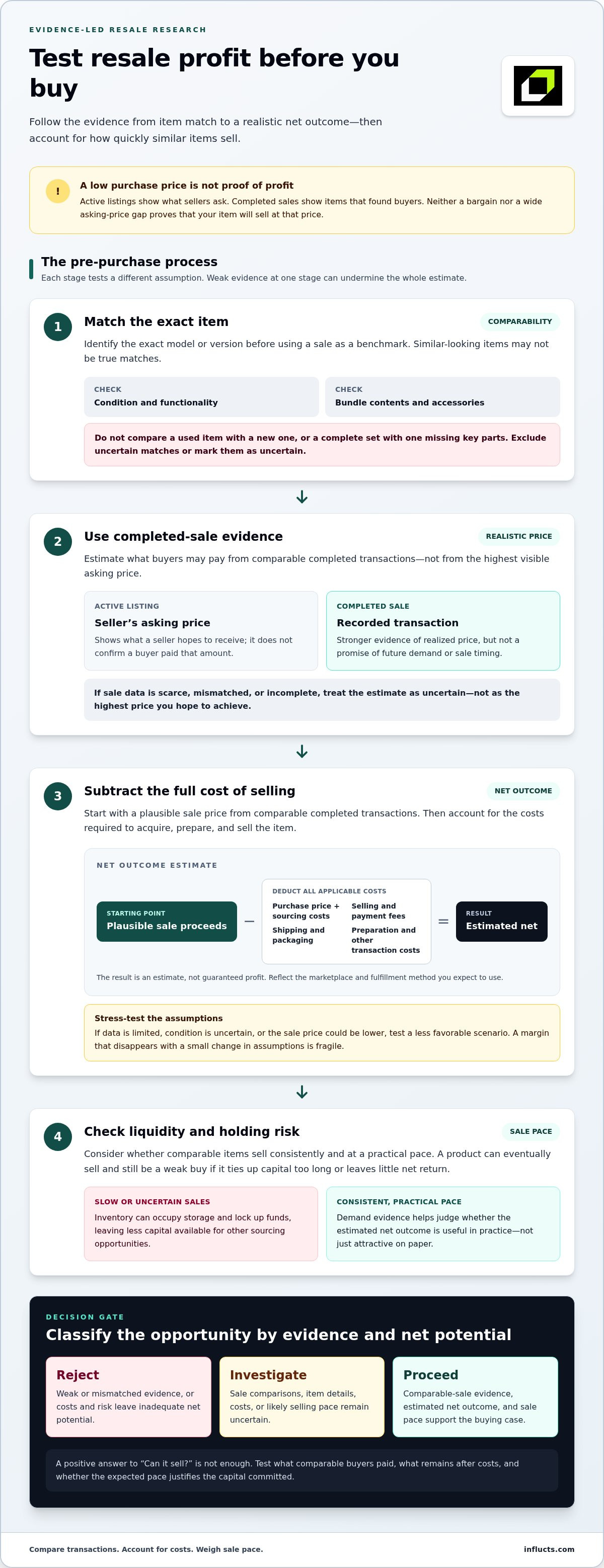
Use a fixed sequence before committing capital: match the item, inspect completed sales, estimate all costs, then assess liquidity. Each step tests a different assumption. A strong result at one stage can’t compensate for weak evidence at another. This process turns “it looks profitable” into a decision grounded in comparable transactions and realistic net proceeds.
Completed sales are records of past transactions, not a promise of future demand. Treat them as evidence for an estimate, then consider whether current demand and likely sale timing make that estimate useful. To avoid buying unprofitable resale products, base your calculation on plausible outcomes rather than the best visible price.
Match comparable items before using sale data
Start by identifying the exact item you plan to buy. Separate true matches from products that merely look similar in search results. Verify the model or version, condition, bundle contents, and included accessories. Don’t benchmark a used item against a new one, or a complete set against a listing missing key parts.
Check listing details that could affect price, such as whether the item is tested, functional, or sold with its original components. If you can’t establish that a sale refers to the same product in a comparable condition, exclude it or mark the comparison as uncertain. Don’t fill gaps with assumptions about identity or completeness.
Calculate a conservative net outcome
Estimate a plausible sale price using comparable completed transactions, not the highest active listing. Then subtract the costs required to acquire, prepare, and sell the item. Reflect the marketplace and fulfillment method you expect to use.
- Acquisition: Include the purchase price and any directly related sourcing costs.
- Marketplace and transaction costs: Account for applicable selling and payment fees.
- Fulfillment: Estimate shipping, packaging, and any preparation needed to make the item sale-ready.
- Other applicable costs: Include relevant expenses tied to the transaction instead of treating them as incidental.
Subtract those costs from the plausible sale proceeds. The result is an estimated net outcome, not a guaranteed profit. If comparison data is limited, the item’s condition is uncertain, or the sale price could reasonably be lower, test a less favorable scenario too. A margin that disappears when assumptions change slightly is fragile.
Finally, assess liquidity: consider whether comparable items have sold consistently and whether the likely time to sale fits your inventory strategy. A product with a positive estimated margin may still be a poor use of capital if demand appears sporadic or funds could remain tied up. Cross-market research and automated profit analysis, such as the tools at INFLUCTS resale research tools, can help organize the evidence. Use the output to inform your judgment, not replace it.
Which Resale Signals Matter More Than a Promising Price Gap?
A visible gap between a low acquisition price and a higher resale listing can attract attention, but it’s only a lead. Before treating it as an opportunity, test whether the items are comparable, whether completed sales support the expected price, and whether demand appears consistent. Then account for likely time to sell. A theoretical margin matters only if buyers transact under conditions close to your assumptions.
Evaluate signals together, not in isolation. Each answers a different question and has a distinct limitation:
| Signal | What it indicates | Limitation |
|---|---|---|
| Apparent price spread | Possible room between acquisition and resale prices | May rely on asking prices, mismatched items, or costs not yet deducted |
| Completed-sale evidence | Comparable items have found buyers at recorded prices | Past transactions don’t establish future demand |
| Demand consistency | Sales appear across more than an isolated moment | Short-term attention can fade or reflect unusual circumstances |
| Likely time to sell | How quickly capital may return to circulation | Past sale patterns can’t guarantee the timing of your sale |
Separate a real opportunity from a false positive
Price comparisons fail when the underlying items differ. A complete bundle may command more than a single item, while a better-condition product may sell above a worn one. If a search result appears similar but the model, condition, or included accessories don’t match, the price gap may be misleading. Exclude weak comparisons instead of using them to support a target price.
Sparse completed-sale evidence should increase uncertainty, not confidence. One strong transaction may show what was possible once, but it doesn’t establish consistent buyer activity. A high theoretical margin isn’t the same as repeated evidence that buyers transact at a comparable price.
Assess liquidity alongside margin
Liquidity is the practical ability to sell an item within a useful timeframe and return the capital to your sourcing pool. A larger possible margin can be less attractive if sales are infrequent or timing is unpredictable. A smaller, better-supported margin may fit your operation more effectively if comparable items sell more consistently.
Look for patterns across comparable transactions rather than relying on a brief burst of attention. Trends can shift, and temporary visibility doesn’t prove durable demand. Check whether activity persists across relevant completed sales, then weigh that evidence against the time and capital you can afford to commit. This is central to how you avoid buying unprofitable resale products.
Cross-market comparisons can help test whether a promising gap holds up across active listings and completed-sale records. Explore INFLUCTS resale market intelligence to support an evidence-led review. Use the findings as decision support, not as a guarantee of future sales.
A Pre-Purchase Checklist for Rejecting Risky Resale Inventory
Use the same evidence gates for every candidate listing. A consistent process reduces the chance that urgency, a low price, or an attractive projected margin will override weak evidence. Product discovery can surface candidates, but evaluate each item on its own data before committing capital.
Run the purchase through five evidence gates
Work through these checks in order. Record what you can verify and flag what remains uncertain.
- Confirm identity. Match the exact model or version in the candidate listing. Confirm condition and included accessories or bundle contents. If you can’t establish what the item is, stop and investigate before comparing prices.
- Review completed sales. Look for comparable transactions, not just active offers. Note whether the sales match the candidate and whether the evidence is consistent. Sparse or mismatched records call for caution, not a more confident estimate.
- Estimate net potential. Start with a plausible sale outcome, then account for acquisition, marketplace, payment, shipping, packaging, and other relevant transaction costs. Don’t treat gross spread as spendable profit.
- Assess liquidity. Consider whether comparable items sell often enough, and quickly enough, for the capital commitment to fit your operation. A possible margin has limited value if the item may sit beyond your useful selling timeframe.
- Refresh the data. Recheck active listings, prices, and relevant completed-sale evidence immediately before purchase. Listings and market conditions change; a calculation based on stale inputs may no longer support the same decision.
Set a decision rule before inventory commitment
Define your evidence threshold before reviewing tempting deals. Specify what counts as a valid comparable, how you’ll handle thin sales data, which costs belong in the calculation, and what net outcome makes the capital commitment worthwhile. A pre-set rule makes decisions more consistent and limits the influence of an unusually attractive asking price.
Reject candidates when identity is unclear, comparisons are weak, or the margin depends on best-case assumptions. Investigate when the item appears comparable but sale evidence or costs remain incomplete. Proceed only when the item is properly matched, the evidence supports a plausible sale outcome, and the estimated net potential meets your criteria. Category-level context, such as these high-margin resale product trade-offs, can inform your research, but it doesn’t replace listing-level verification.
Use this checklist to avoid buying unprofitable resale products through a repeatable reject, investigate, or proceed decision. To apply cross-market research and profit analysis to candidate listings, evaluate resale opportunities with INFLUCTS.
How INFLUCTS Supports More Evidence-Led Resale Decisions
A repeatable verification process depends on useful market evidence and a consistent way to evaluate candidates. INFLUCTS supports that work with AI-powered searches for active marketplace listings across marketplaces in your country, comparisons with completed-sale records, and automated profit analysis. It brings research signals together so you can test a buying thesis before committing capital.
This fits into a broader sourcing process, from identifying possible products to deciding whether a specific listing merits further review. Build your side-hustle sourcing workflow around evidence rather than guesswork, and evaluate each candidate against the same criteria.
Use cross-market data to test a buying thesis
Start with the candidate item and a clear hypothesis: comparable products may sell at a price that leaves a viable net return after relevant costs. Search active listings across marketplaces in your country to observe current offers, then compare them with completed-sale data. Active listings show current competition and seller expectations; completed records provide evidence of transactions that occurred.
Keep the comparison inputs visible. Confirm the model, condition, and included accessories before treating listings or sales as comparable. Then use realistic purchase, marketplace, shipping, packaging, and other applicable cost assumptions in the profit assessment. If the item match is uncertain or the sale evidence is thin, make a cautious decision rather than letting the analysis disguise gaps in the evidence.
Turn research into a repeatable operating process
Automated profit analysis fits after candidate discovery and evidence review. Use it to evaluate prospective items with a consistent calculation, compare opportunities, and identify where assumptions need closer inspection. The software can make candidate evaluation more systematic, but it can’t guarantee buyer demand, a completed sale, or profit. Market conditions change, and the reseller remains responsible for judging the evidence and deciding whether to purchase.
INFLUCTS is resale market intelligence software that supports research and decision-making. It doesn’t sell inventory or broker resale transactions. Its value is in strengthening the process before a purchase, not removing uncertainty from the market. Use the findings alongside your own checks, and refresh the relevant data before acting.
To avoid buying unprofitable resale products, make evidence review part of every sourcing decision. Explore INFLUCTS to bring cross-market search, completed-sale comparisons, and profit analysis into your resale research workflow.
Make Every Purchase Decision More Repeatable
Turn each sourcing decision into useful feedback. Keep a brief record of what you expected, why the opportunity met your criteria, and what happened after purchase. Over time, compare those expectations with your results. Use the differences to refine your decision rules, spot recurring blind spots, and allocate capital with greater discipline.
This makes it easier to avoid buying unprofitable resale products without relying on instinct or chasing every promising listing. Not every candidate will qualify. Rejecting a weak opportunity is productive when it preserves room for stronger ones.
Build your process around evidence, then apply it consistently to the next item you consider. Explore INFLUCTS resale market intelligence to support your research workflow. Evaluate each purchase with discipline to make the next decision sharper.
Frequently Asked Questions
Can a cheap resale product still lose money after marketplace fees?
Yes. Fees can reduce the amount you keep enough to erase an apparent margin, especially on low-priced items. If the expected sale price leaves little room after the purchase cost, ordinary transaction and fulfillment expenses may push the result below your target. Include any item-specific preparation, return handling, or discounting you reasonably expect. A low acquisition price doesn’t make the net calculation optional.
How many completed sales should I review before buying resale inventory?
There’s no universal count that makes a purchase safe. Review enough comparable transactions to see whether prices and sales activity form a useful pattern, rather than relying on one unusually high result. For a niche item, evidence may be limited; treat that as added uncertainty. Separate different conditions, versions, and bundles, and compare sales from a relevant period so older transactions don’t dominate your estimate.
Do active marketplace listings show what a product will actually sell for?
No. Active listings show current competition and the prices sellers are asking, not confirmed buyer spending. They can still help you understand how crowded the market is and whether your planned listing would be positioned competitively. For example, several similar items with long-standing listings may signal that sellers are struggling to convert interest into sales. Use active offers as context, not as a forecast of your sale price.
Can a trending resale product become unprofitable before it sells?
Yes. A trend can weaken while inventory is in transit, being prepared, or waiting for a buyer. If attention shifts, sellers may compete by lowering prices, reducing the resale value you expected. Before sourcing, consider how dependent the opportunity is on current attention and whether it has other demand drivers. Avoid increasing order size solely because a product is receiving short-term visibility.
Should I test a single item before buying resale inventory in bulk?
Testing one item can limit initial exposure and reveal practical issues, such as whether the listing attracts interest or the item takes more preparation than expected. But one successful sale doesn’t prove that a larger quantity will sell at the same price or pace. Treat a small test as a way to collect evidence, then reassess demand, costs, and your capacity before scaling. That discipline can help you avoid buying unprofitable resale products.
How often should resellers refresh product research before purchasing?
Refresh the research shortly before committing to a purchase, especially if time has passed since the original comparison or the item is tied to changing demand. Recheck current competing offers, recent comparable transactions, and your cost assumptions. A meaningful change in any of these inputs can alter the decision. For repeat sourcing, revisit candidates before each order rather than relying on saved research indefinitely.
Can resale research software guarantee that a product will be profitable?
No. Software can organize market evidence and apply cost assumptions, but it can’t guarantee that buyers will choose your listing, that demand will hold, or that a sale will meet your estimate. INFLUCTS supports evaluation with marketplace research and automated profit analysis. You still need to assess whether the product matches the comparison data, whether your inputs are realistic, and whether the remaining uncertainty is acceptable.


