

What if the product that looks most profitable is the one most likely to tie up your cash? When you’re searching for “Make extra money in cost of living” ideas, resale can seem straightforward: buy low, list high, pocket the difference. But asking prices don’t prove demand, and a projected sale price isn’t your take-home amount.
Choosing an item based on intuition or a promising listing can be risky, especially when your time and budget are limited. The key question is whether buyers are completing sales at a price that leaves room for a margin after marketplace fees, shipping, and other costs.
This article offers a practical checklist to help you assess demand, compare active listings with completed-sale evidence, estimate net proceeds, and spot risks before committing money. It also explains how multi-marketplace research and automated profit analysis, including INFLUCTS, can reduce manual comparison work. The goal isn’t to guarantee a winning product. It’s to screen opportunities with evidence, calculate likely costs, and make an informed decision about where your limited capital goes.
Key Takeaways
- To Make extra money in cost of living, screen resale products with evidence before spending limited capital.
- Compare like-for-like items by condition, model, included components, and listing details before judging sale activity.
- Separate the apparent price spread from estimated net proceeds by accounting for fees, shipping, and other costs.
- Weigh completed-sale evidence and competing supply against the time and effort each product requires.
- Use a consistent validation checklist, then streamline cross-marketplace research with live listing comparisons and automated profit analysis.
Making Extra Money Through Reselling Starts with a Testable Product
Pressure on household budgets can make an additional income stream appealing. But resale income is uncertain, and buying inventory carries risk: an item may take time to sell, attract little interest, or cost more to prepare and ship than expected. The broader pressures behind the ongoing cost-of-living crisis make careful decisions more relevant, not less.
This guide focuses on one decision: whether a specific product candidate deserves further research before you commit money. It doesn’t rank every side hustle or suggest that reselling is a fast route to income. If you’re searching for “Make extra money in cost of living” ideas, treat resale as a product-selection problem first. A promising listing is a lead, not proof of future profit.
What does it mean to validate a resale product?
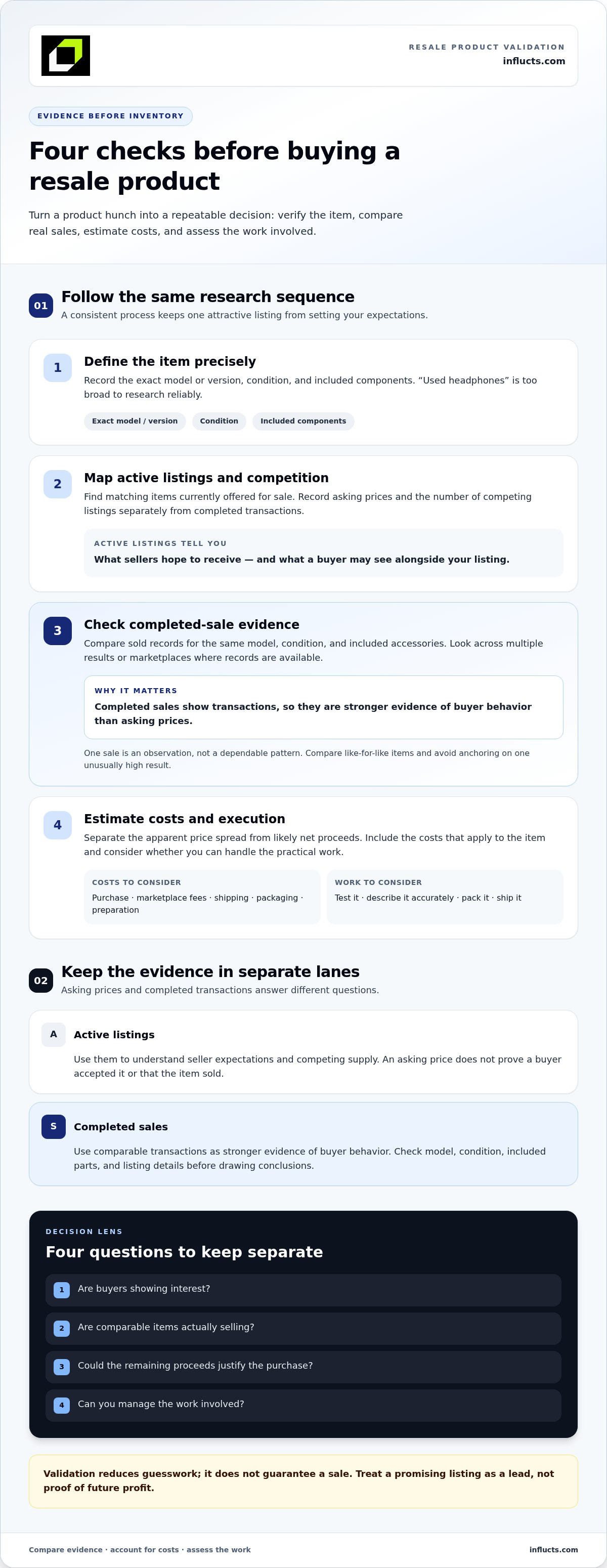
Product validation means checking demand, completed-sale evidence, likely costs, and your ability to handle an item before buying it for resale. It’s a sequence of evidence checks, not a forecast that guarantees a sale. Keep four questions separate: are buyers showing interest, are comparable items actually selling, could the remaining proceeds justify the purchase, and can you manage the work involved?
For example, a used device may look attractive at first glance. Before treating it as an opportunity, establish the exact model and condition, then check whether sold examples include the same components. An item missing a charger or showing wear may not be comparable to a clean, complete listing. Your ability to test, describe, pack, and ship it also affects whether the candidate fits your time and skills.
Why active asking prices are not enough
An asking price shows what a seller hopes to receive. It doesn’t show that a buyer accepted that price, or that the item sold at all. A high-priced listing can remain available while cheaper alternatives attract actual transactions. Treat active listings as information about competing supply and seller expectations, not direct proof of market value.
Completed-sale records offer stronger evidence of buyer behavior because they show transactions rather than intentions. They still need context: a sale is useful only if the item is genuinely comparable in model, condition, included parts, and listing details. Look for a pattern across relevant sales instead of anchoring your estimate to one unusually high result. Then weigh that evidence against current competition and likely costs.
This distinction is central to the data-led sourcing system: separate observed sale evidence from asking prices before estimating an opportunity. A candidate becomes more credible when demand signals, comparable transactions, costs, and execution requirements align. Even then, validation reduces guesswork; it doesn’t remove uncertainty or guarantee that your own item will sell.
How to Validate Resale Demand with Listings and Completed Sales
Use the same research sequence for every candidate. A repeatable process helps keep one attractive listing from setting your expectations. For anyone looking for “Make extra money in cost of living” options, this workflow turns a product hunch into an evidence-based decision while keeping uncertainty visible.
- Define the item precisely. Record its exact model or version, condition, and included components. “Used headphones” is too broad to research reliably. A specific model with its accessories identified gives you a clearer comparison target.
- Find comparable active listings. Search for matching items currently offered for sale. Note asking prices and the number of competing listings separately from completed transactions. Active supply shows what a buyer might see alongside your listing.
- Inspect completed-sale evidence. Compare sold records for the same model, condition, and included accessories. Look across multiple results or marketplaces where records are available. One sale is an observation, not a dependable pattern.
- Assess costs and execution. Estimate the purchase, marketplace, shipping, packaging, and preparation costs relevant to the item. Consider whether you can test it, describe it accurately, and handle delivery before deciding whether the evidence supports a purchase.
Find genuinely comparable active and completed listings
Search narrowly, then widen the search only if results are sparse. Match the exact model and version first. Filter for condition, and check whether accessories or other components are included. Read listing details for faults, upgrades, or missing parts that affect value. A complete, tested unit shouldn’t be treated as equivalent to an untested one missing key components.
Keep two sets of research notes: one for active asking prices and competing supply, and another for completed transactions. Combining them can make expectations look like evidence. Check records from multiple marketplaces when possible, but don’t assume different platforms or listing formats are directly interchangeable. Record where each result came from and what makes it comparable.
Read demand signals without overinterpreting them
Choose an observation window that fits the item category, then compare completed-sale activity with active supply over the same period. Sold data is stronger than asking prices because it records completed transactions rather than a seller’s intended price, but it still doesn’t guarantee a future sale. A high count of active listings may indicate heavy competition, not strong demand.
Flag evidence as uncertain when sold records are sparse, old, or inconsistent in condition and sale price. Don’t turn a single matching transaction into a trend or treat missing data as proof that demand is absent. Instead, research the candidate further or set it aside until you have enough comparable evidence to make a reasoned estimate.
Comparing live listings with completed-sale records across marketplaces can reduce manual research. INFLUCTS resale market intelligence supports that process with live listing search, completed-sale comparison, and automated profit analysis. Use those outputs as research inputs, not a promise of demand or profit.
Compare Resale Candidates by Net Margin, Time, and Downside
A wide gap between a purchase price and an active listing price can look attractive. It’s only a gross spread, not an estimate of what you’ll keep. Compare each candidate using completed-sale evidence, current competition, expected costs, and the work required to prepare and fulfill an order. If your goal is to “Make extra money in cost of living,” weigh the downside as well as the potential upside.
Estimate net proceeds before deciding
Start with a realistic expected sale amount supported by comparable completed transactions. Then subtract the sourcing cost, applicable marketplace fees, shipping, packaging, and any likely return-related expenses. The result is an estimate, not a promise: fees can depend on platform rules and item category, while shipping depends on the parcel and destination. Check the current terms for the marketplace and transaction you’re evaluating.
For example, as of October 2026, eBay’s final value fee for most categories is 13.6% of the total sale amount up to $7,500, plus 2.35% on the portion above that. A per-order fee also applies: $0.40 for orders over $10, or $0.30 for orders of $10 or less. Verify the current category-specific terms before using a rate in your calculation. Label estimates clearly, especially where shipping or returns could change the result.
| Candidate | Sale evidence | Competing supply | Estimated costs | Handling effort |
|---|---|---|---|---|
| A | Several recent comparable sales | Moderate active supply | Fees and shipping estimated; return exposure considered | Testing and careful packing needed |
| B | Sparse or inconsistent sale records | Many similar listings | Shipping and preparation costs uncertain | More research and storage effort |
The table isn’t a verdict. It makes gaps visible. Candidate A has clearer evidence, but its handling demands still matter. Candidate B may need more research before its apparent spread is meaningful. Explore high-margin resale product trade-offs for broader category-level context, but assess each specific item on its own evidence.
Compare money exposure with time and uncertainty
Record the purchase commitment alongside research time, listing effort, storage needs, and shipping complexity. A product that ties up more cash or requires specialized handling may be a poor fit even if its estimated proceeds look higher. Prioritize candidates with clearer evidence and manageable downside for your available resources.
Research reduces avoidable uncertainty, but it can’t eliminate changes in demand, unexpected condition issues, returns, or execution mistakes. Keep assumptions visible and decide what evidence would make you walk away. Automated profit analysis and cross-market comparisons can help organize the inputs, but the final estimate remains a planning tool, not a guarantee of profit.
Use This Resale Product Validation Checklist Before You Buy
A fixed checklist makes it harder to rationalize a purchase based on one attractive price or a promising hunch. Before sourcing an item, capture the evidence and assumptions behind your decision. If you’re looking for ways to “Make extra money in cost of living,” set your limits first: decide how much cash, time, and uncertainty you can accept before assessing a candidate.
The pre-purchase evidence checklist
Complete each check for the exact item you intend to source. If a key detail is unknown, record it as a gap instead of filling it with an optimistic assumption.
- Product identity: Record the exact model, version, condition, and included components.
- Comparable quality: Confirm that sold examples match the item’s condition, accessories, and relevant listing details.
- Sale evidence: Note completed transactions, the marketplace, and the date you checked the records.
- Evidence strength: Flag results that are sparse, outdated, inconsistent, or difficult to compare.
- Current supply: Record active competing listings separately from completed sales.
- Net-proceeds estimate: Start with a realistic sale amount, then subtract sourcing, marketplace, shipping, packaging, and likely return-related costs.
- Assumptions: Identify estimates that could change, and use current marketplace terms and cost inputs.
- Operational fit: Assess the time, storage, testing, listing, packing, and shipping effort involved.
When to proceed, research further, or reject
Set decision criteria before looking at candidates. Define your maximum cash commitment, acceptable workload, and minimum estimated proceeds after costs. These are personal limits, not universal thresholds. A clear standard helps prevent an appealing listing from shifting your criteria after the fact.
- Proceed to a small test only when comparable completed sales support your estimate, the cost calculation uses current inputs, and the exposure fits your preset limits. A test is still a risk, not a guaranteed result.
- Research further when comparable sales are limited, conflicting, or hard to match. Recheck the item details, expand marketplace comparisons where useful, or wait for stronger evidence.
- Reject the candidate when likely costs, required effort, or unresolved uncertainty exceed your limits. Walking away protects the capital and time you haven’t committed.
Keep the checklist with your research notes. INFLUCTS supports the evidence-gathering stage with live marketplace listing search, comparisons with completed-sale data, and automated profit analysis. Use these capabilities to organize your assessment, not to treat an estimate as a guarantee. Use INFLUCTS to compare resale evidence and estimate profit.
Validate Products Faster with INFLUCTS Resale Market Intelligence
Turning a shortlist into a defensible decision takes more than checking one marketplace. You need to find current competition, locate completed-sale evidence, and compare the figures without confusing asking prices with actual transactions. Repeating that process across marketplaces can take time and make it harder to keep research consistent.
For side hustlers looking for ways to “Make extra money in cost of living,” research tools can help organize product screening. They can’t remove resale risk or decide whether an item fits your budget, available time, and ability to fulfill a sale.
Apply the checklist using cross-market research
INFLUCTS searches live marketplace listings across markets, giving you a broader view of active supply and potential product candidates. A wider search can surface more options to compare, but more listings don’t automatically mean stronger demand. Use the exact product details to assess whether each result is genuinely comparable.
The platform also compares active listings with completed-sale data. Completed transactions provide evidence of buyer behavior and can inform your expected sale-price research. Review the product match, condition, and included components before using those records as a benchmark. A comparison is only as useful as the evidence behind it.
Automated profit analysis helps assess prospective margins by bringing product research and cost considerations into the evaluation. Treat the output as decision support, not a guarantee. Your estimate still depends on accurate assumptions about the item, purchase cost, marketplace fees, shipping, packaging, and other relevant expenses. Market conditions and your own execution can also affect the final result.
Move from product candidate to informed next step
Before deciding whether to buy, make sure your research captures the key inputs in one place:
- Product match: Exact model, version, condition, and included components.
- Market evidence: Comparable active listings and completed sales, with the marketplace and research date recorded.
- Cost estimate: Expected sale amount and relevant sourcing, fee, shipping, packaging, and return assumptions.
- Execution fit: The time, effort, storage, and handling the item requires.
If the records are weak or the assumptions don’t fit your limits, pause or reject the candidate. If the evidence is credible and the potential exposure is manageable, you can make a more informed next-step decision. INFLUCTS is designed for side hustlers who want structured marketplace research, with live listing search, completed-sale comparison, and automated profit analysis supporting the validation process.
Explore INFLUCTS resale intelligence to compare marketplace evidence and evaluate resale candidates with more structure.
Make Your Next Resale Decision Deliberate
Use your next sourcing session to test one candidate against limits you set in advance. Decide how much money you’re prepared to commit, how much time you can allocate, and what level of uncertainty is acceptable. Those boundaries turn research into a practical decision instead of a reason to justify a purchase you already want to make.
If “Make extra money in cost of living” is your goal, focus on building a repeatable process rather than expecting one product to solve budget pressure. Record what you expected, what happened, and which assumptions proved wrong. Over time, those notes can sharpen your judgment and help you recognize when an opportunity doesn’t fit your resources.
Structured research can make that process easier to maintain. Explore INFLUCTS resale market intelligence as you evaluate your next product candidate. Start with a measured decision, learn from the evidence, and keep your next step within limits you can manage.
Frequently Asked Questions
Can reselling make extra money during a cost-of-living crisis?
Reselling can generate extra income, but results depend on what you source, what buyers pay, and the costs and work involved. It isn’t a reliable short-term fix for household budget pressure. If you want to Make extra money in cost of living, set a spending limit and decide how long you can wait for a sale before sourcing items. Start with a candidate whose potential loss wouldn’t disrupt essential expenses.
How do I validate a resale product before buying it?
Research the precise item before committing funds. For example, if you’re considering a game console, distinguish its model and condition, and whether controllers or cables are included. Check for comparable completed sales, then compare current competition and estimate proceeds after relevant costs. Note when and where you gathered the evidence. If key details don’t match or the estimate relies on uncertain assumptions, delay the purchase instead of treating the gap as an opportunity.
What is the difference between an active listing and a completed sale?
An active listing is an item currently offered for sale at the seller’s chosen price. A completed sale records a transaction that occurred. If similar lamps are listed at one price but comparable completed sales show buyers paid less, the active listings alone could inflate your estimate. Neither record predicts your result: listings reveal current competition, while completed sales provide historical evidence of buyer behavior.
How can I estimate resale profit after fees and shipping?
Begin with a realistic expected sale price based on comparable completed transactions. Subtract your purchase or sourcing cost, applicable selling fees, shipping, packaging, and other likely expenses, such as handling a return. Use the marketplace’s current fee terms and a shipping estimate for the actual parcel and destination. Record uncertain inputs separately, then test how a lower sale price or higher shipping cost changes your estimate.
How many completed sales should I check before reselling a product?
There isn’t one number that makes a product safe to buy. The evidence matters more than reaching a fixed count. Look for enough recent, closely matched transactions to see whether sale prices and activity form a reasonably consistent pattern. If results are sparse, outdated, or vary because items have different conditions or accessories, treat the estimate as uncertain. Gather more comparable evidence or choose a better-supported candidate.
Can I validate resale demand across multiple marketplaces?
Yes. Comparing more than one marketplace can reveal differences in current competition and completed-sale evidence, giving you a broader research view. Keep each source identifiable in your notes, and don’t combine results blindly: platform audiences, listing details, and transaction data may differ. INFLUCTS searches live marketplace listings across markets and compares active listings with completed-sale data, helping organize cross-market research for product evaluation.
Does resale research software guarantee that a product will sell?
No. Software can organize marketplace evidence and support an estimate, but it can’t guarantee buyer interest, a sale price, or a profitable outcome. Product condition, listing quality, timing, costs, and execution still affect results. Use research outputs as decision support, verify important assumptions, and set a maximum purchase commitment in advance. If the evidence doesn’t meet your criteria, don’t buy simply because a tool shows a possible opportunity.


